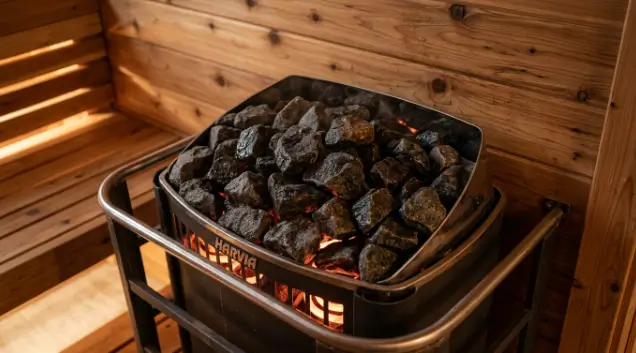
When a full-size 6 kW to 9 kW traditional heater will not fit a room’s clearance requirements or wiring, three realistic alternatives exist: a smaller 3 kW to 4.5 kW electric package built for tight cabins, carbon or ceramic infrared panels that heat the body directly instead of the air, or a low-wattage 120V plug-in unit that skips electrical upgrades entirely. Each trades something, usually peak temperature or steam quality, for a smaller footprint.
Why doesn’t a standard sauna heater fit every small space?
A full-size 6 kW to 9 kW traditional heater needs both a dedicated 240V circuit and manufacturer-specified clearance to combustible surfaces on multiple sides, often 4 to 8 inches depending on the model, plus front clearance for stone loading and guard rail access. In a genuinely tight room, a closet conversion, a small shed corner, or a cabin under roughly 70 cubic feet, those clearance requirements alone can rule out a standard unit before wiring even becomes a question. That is the point where it makes sense to look at smaller-format alternatives instead of forcing a full-size heater into a space it was not designed for.
Option one: a smaller electric heater built for tight cabins
Compact electric units in the 3 kW to 4.5 kW range exist specifically for single-person cabins in the 45 to 90 cubic foot range. They still use stones and still need a dedicated circuit in most cases, though the amperage draw and clearance requirements shrink along with the output. This is the closest option to a traditional sauna experience in a genuinely small footprint, since it keeps the stone bed and loyly (steam from water on hot stones) that infrared setups do not offer. The tradeoff is a longer heat-up time relative to a bigger heater, since less wattage means the room takes longer to reach its target temperature.
Option two: carbon or ceramic infrared panels
Infrared panels heat the body directly through radiant energy rather than heating the surrounding air, which means they work in shallower cabins than a stone-based heater needs and generally run on standard 120V power. Carbon panels spread heat across a wider surface at a slightly lower intensity, while ceramic panels concentrate heat more directly and run a bit hotter at the same wattage. Neither produces steam, so the traditional loyly ritual is not part of an infrared setup, and operating temperatures run notably lower, typically 120 to 150 degrees Fahrenheit compared to 150 to 195 for a traditional heater. For a space too tight for stone-heater clearances, this is usually the best-fitting option.
Option three: a low-wattage 120V plug-in unit
For the smallest spaces or the lowest-effort installs, a plug-in heater under about 1.8 kW to 2 kW runs on a standard household outlet with no electrical upgrade at all. This is the fastest path to a working sauna in a small space, since it skips permitting and panel work entirely, but it comes with real limits: slower heat-up, lower peak temperature, and less consistent heat retention in a room with any real air leakage. It works best as a starter setup or in a very small, well-sealed cabin rather than as a long-term substitute for more output.
How do you decide between these three when space is genuinely tight?
If keeping the stone-and-steam experience matters most, a smaller electric heater is worth the extra clearance and wiring work over an infrared panel. If the room’s shape or depth makes clearance the real constraint rather than wattage, infrared panels typically fit where a stone heater physically cannot. If the goal is the simplest, cheapest path to any working heat source, a 120V plug-in unit gets there fastest, with the understanding that it is a smaller experience than a full traditional session. Reviewing package specs and clearance figures across sizes, including full-size options for comparison, at the SweatDecks the Harvia KIP collection helps put the smaller alternatives in context against what a standard 6 kW unit actually requires.
Do smaller heaters still need real clearance and safety consideration?
Yes, without exception. Even a low-wattage plug-in unit or an infrared panel needs manufacturer-specified distance from wood surfaces, and ground-fault protection is still standard practice on the circuit regardless of amperage. Smaller output reduces the clearance numbers, it does not eliminate the requirement. Skipping this step because a unit “feels” low-risk due to its size is a common mistake with small-space installs specifically.
Is a smaller or lower-temperature setup still worth it for the health-related upside people associate with sauna use?
The sauna research base is built mostly around traditional Finnish-style bathing at higher temperatures, and a Mayo Clinic Proceedings review of that literature found regular sessions associated with favorable cardiovascular and general wellness markers among consistent users. A systematic review in Evidence-Based Complementary and Alternative Medicine looking specifically at regular dry sauna bathing found similar associations across the studies it covered. Neither body of evidence specifically isolates lower-temperature infrared use, so the honest answer is that smaller or cooler setups are a reasonable practical compromise for a tight space, but the strongest evidence base still centers on regular, higher-heat traditional sessions.
Frequently Asked Questions
What is the smallest electric sauna heater available?
Compact electric heaters start around 3 kW for very small cabins, roughly 45 to 70 cubic feet, though most manufacturers recommend at least 4.5 kW for consistent heat retention in anything larger than a single-person space.
Can infrared panels replace a full electric sauna heater in a tight space?
Yes, in a genuinely small footprint. Carbon or ceramic infrared panels heat the body directly rather than the air, so they work in shallower cabins than a stone-based electric heater needs, though they do not produce the steam or loyly of a traditional heater.
Is a 120V plug-in heater a real option for a small space?
For low-wattage units under about 1.8 kW to 2 kW, yes. These run on a standard outlet without electrical upgrades, making them the lowest-effort option for a small space, though they heat slower and reach lower peak temperatures than a 240V unit.
What clearance does the smallest sauna heater still need?
Even the smallest electric or infrared heaters need manufacturer-specified clearance from combustible surfaces, commonly a few inches at minimum. Clearances shrink with output but never disappear entirely.
Does a smaller heater mean a shorter or cooler session?
Not necessarily shorter, but often lower peak temperature. Small electric and infrared units can still run long sessions, they just typically top out cooler than a full-size 6 kW to 9 kW traditional heater in a larger room.
References
- Clinical Effects of Regular Dry Sauna Bathing: A Systematic Review, Evidence-Based Complementary and Alternative Medicine, 2018
- Cardiovascular and Other Health Benefits of Sauna Bathing: A Review of the Evidence, Mayo Clinic Proceedings, 2018
- Benefits and risks of sauna bathing, The American Journal of Medicine, 2001
By Natalie Kwan